Braided Essay Structure for Personal Nonfiction
Weaving distinct threads creates meaning that no single narrative line could achieve alone.
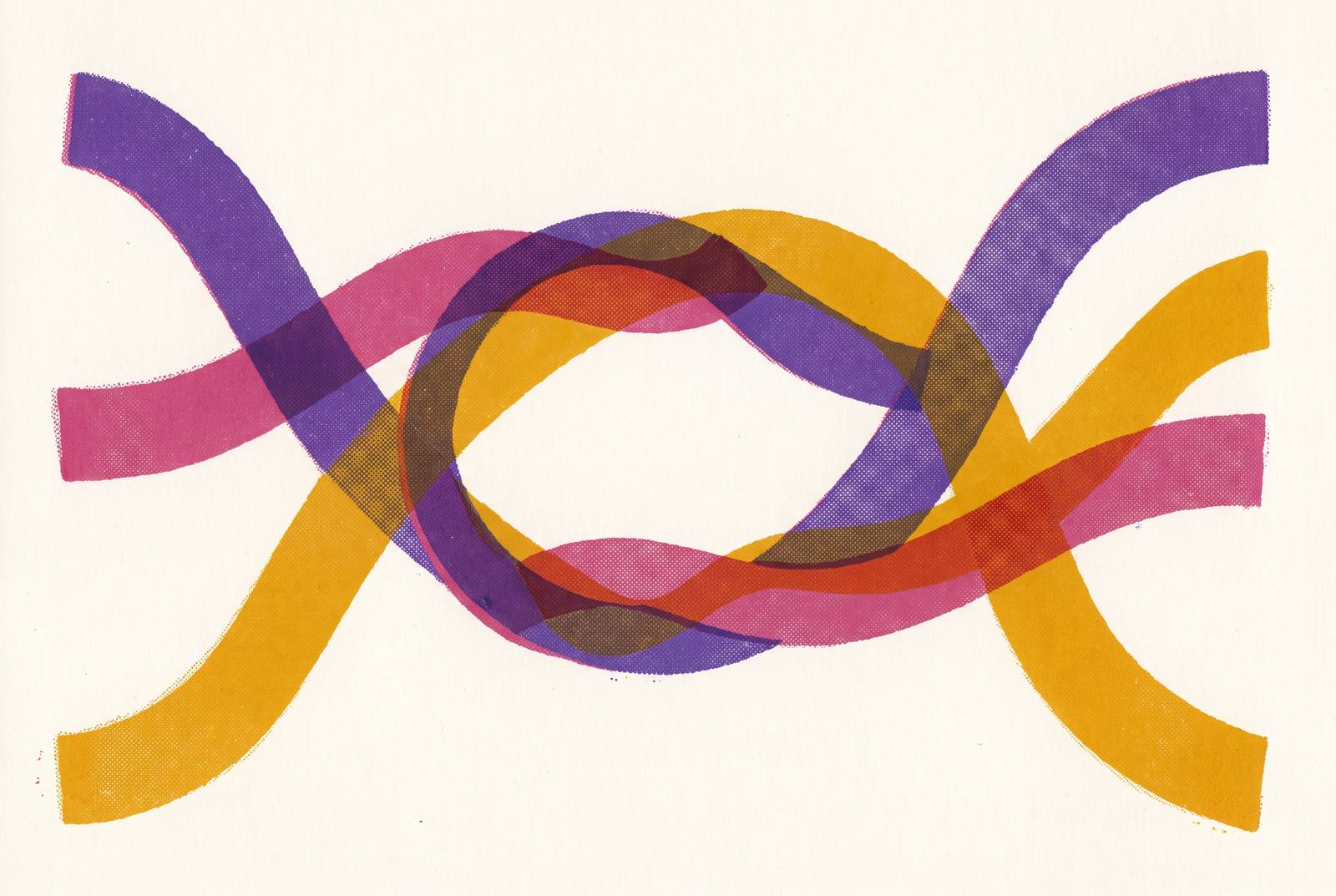
A braided essay is a structure in which two or more sufficiently distinct threads are placed in deliberate conversation so that meaning emerges from their juxtaposition rather than from any single thread alone. Writers.com's craft guide describes it the same way: a braided essay weaves two or more distinct "threads" into one piece, and when the weave works, the whole becomes greater than the sum of its parts.
The word "thread" is doing real work here, and it is not interchangeable with "section" or "chapter." A thread about that illness braided against a thread about, say, the migration pattern of a bird species is two threads, because nothing about the bird thread derives from or depends on the illness thread.
What distinguishes a true braid from a merely fragmented essay is the kind of work the fragmentation is doing. A braided essay depends on friction between unlike materials: the threads push against each other the way two forces generate pressure between them, and the pressure is where the meaning sits. Nicole Walker put this directly: the tension between two unlike things working against each other, given enough stress and enough repetition, presses out meaning, and the further apart the threads are, the more the finished essay resists being reduced to a single easy answer. That resistance is not a side effect. It is why thread selection, which later sections return to in detail, determines how the threads bear on each other more than any question of pacing or style.
Subjects That Resist a Single Explanatory Line
The braid exists to solve a specific problem: some subjects cannot be told honestly as a single line running from cause to effect. Scott Fitzgerald called first-rate intelligence: the ability to hold two opposing ideas in mind at once. The braid is the formal version of that capacity. It does not ask the writer to decide which thread is primary. It asks the reader to carry both.
This has a political dimension as well as a structural one, and the two are connected rather than separate arguments. At the AWP 2024 panel "The Braided Essay as Change Agent," panelists argued that the braid works as a feminist refusal of the linear hero's journey, a way of asserting queer complexity, and a structural method by which marginalized writers can decline the demand to produce one clean, legible story about themselves. The structural claim and the political one are the same claim, applied at different scales: a form that refuses linearity for a subject also refuses it for a writer whose life does not fit the shape a single throughline would impose.
Nicole Walker's 2022 essay about her abortion, published in the New York Times, shows what that refusal buys a writer in practice. The juxtaposition does the work that direct, sequential testimony cannot do alone: it gives the reader room to approach difficult material sideways rather than head-on.
Sarah Minor, speaking at the same AWP panel, pointed to an essay published in Assay that used creative nonfiction to train first responders on how to work with survivors of sexual assault. The nonlinear braid called attention to details that a sequential, chronological account would have smoothed over or lost entirely. That is a concrete, almost clinical demonstration of the form's purpose: certain details only become visible when two unlike materials are set beside each other, because the comparison itself produces the noticing. A straight line through the same material would have required the writer to decide, in advance, what the one correct point of emphasis was. The braid doesn't require that decision; in subjects where there is no single correct point of emphasis, the form suits the problem rather than merely dressing it up.
How published braided essays use thread selection to generate tension rather than illustration
The quality of a braided essay depends on what the writer chooses to put beside what. Threads selected because they resist or complicate each other produce the tension the form is built to generate, and several widely read essays show how that selection actually works on the page.
Terry Tempest Williams's Refuge braids the Bear River Migratory Bird Refuge together with her mother's cancer. The way cancer moves through a body and the way birds move through a flyway are not metaphors standing in for each other. They hold each other in productive stress, and the reader is left to draw the connection rather than being told what it is.
Roxane Gay's "What We Hunger For" places The Hunger Games and its pop-cultural treatment of female strength against Gay's own childhood memories. Writers.com's analysis of the piece notes that the combination gestures toward themes that neither thread, taken alone, could have reached.
Its threads range from philosophy to personal suffering, from the study of vision to the fact of pain, held together not by a shared theme but by a single, slender organizing device established at the outset, the narrator's love of the color blue, the clearest case in the form of threads chosen to be maximally unlike, held together by a unifying principle so minimal it barely counts as connective tissue, and it works anyway.
Melissa Febos's "The Mirror Test" runs three main strands at once: personal narrative, evidence-based research, and critical response to pop culture, thickened further with theory, literary analysis, and interviews with women speaking from minoritized subject positions. Candace Walsh went so far as to map the essay's structure in Excel, and found patterns of unspooling, synthesis, and weave that were irregular in a deliberate, crafted way rather than by accident. That detail matters beyond this one essay: it shows that a piece reading as purely lyric and intuitive on the page can have a structure precise enough to chart in a spreadsheet, which is the same claim the next section makes about pacing.
Madhushree Ghosh's Khabaar: An Immigrant Journey of Food, Memory and Family extends the braid past a single essay into a full collection. Across all five of these cases, the threads were chosen because they approach a shared set of questions from angles that cannot be reconciled into one.
How pacing and recurrence shape whether threads resonate or merely alternate
Choosing unlike threads gets a writer only partway there. Brenda Miller's essay "A Braided Heart" uses multiple strands, several of which repeat across the piece, and the repetition is not redundant. A thread that reappears unchanged has not been paced; it has simply been inserted again.
The most common failure mode here is mechanical alternation: a strict A-B-A-B pattern that reassures the reader with its predictability but forecloses any possibility of surprise. Walsh's mapping of "The Mirror Test" found the opposite: patterns that were irregular on purpose, with strand length and return timing varying throughout, and that variation is itself doing meaning-making work rather than simply decorating the structure. Students are given a real choice among a strictly alternating braid, a collage-like braid, or a structure governed by association, intuition, or transition, using crots, headings, or transitional sentences as the connective tissue between strands. Pacing is a decision a writer makes.
Some of that decision-making happens away from the sentence level, in how the structure itself is arranged. Margo Steines's Writers.com course, "Finding Confidence in the Braided Essay," teaches students to use index cards on a wall or floor to lay out the structure physically, and to borrow the sonic rhythms of poetry as a way of linking chunks of material that have no obvious logical connection. Both techniques treat pacing as a spatial problem rather than a sequential one: a writer looking at index cards on a wall can see where one thread has gone quiet for too long, in a way that is much harder to notice while reading a manuscript start to finish.
Past a certain number, the reader can no longer hold each strand in mind clearly enough to notice when it returns, and the tension the braid depends on dissolves into confusion rather than resolving into resonance.
Building coherence without resolving the threads' tension
A braided essay has to hold together as a single piece of writing without explaining what its threads mean in relation to each other, and this is the hardest craft problem the form presents. The coherence it needs is not the coherence of an argument, where premises lead to a conclusion, and it is not the coherence of a plot, where events lead to a resolution. In Bluets, Nelson's love of the color blue is established at the very beginning of the book and works as an organizing principle slender enough that it barely explains anything, yet sufficient to give the reader a place to stand while moving through material that ranges from philosophy to the fact of her own suffering. The device does not tell the reader why vision and pain belong in the same book. It simply gives the reader somewhere to stand while experiencing both, and that is a different, and smaller, kind of work than resolution.
A writer who ties the threads together too neatly commits the opposite failure of the one the overuse section addresses below: an over-explained connection turns productive tension back into illustration, and the reader, who is generally smarter than the draft gives them credit for, notices the demotion immediately. The connection has to arrive as recognition the reader reaches on their own. Eula Biss's "Time and Distance Overcome" begins as a history of telephone poles and becomes, by its end, a meditation on race, and the turn is never announced. It accumulates, piece by piece, until the reader recognizes the connection rather than being told it exists.
That places real demands on both sides of the page. The writer bears the greater burden of that bargain. The discipline of the form is tolerating that open question long enough for the reader to arrive at their own answer, and that patience is a skill a writer can develop, not a talent some writers simply have.
Where the form is genuinely contested
Two objections to the braided essay deserve to be taken seriously rather than waved off, and both sharpen rather than weaken the argument for the form. The first is that the structure has been overused to the point of becoming a default move rather than a deliberate choice. Naomi J. Williams's piece "Braids: A Braided Essay About Braids & Braided Essays" makes this case from inside the form itself, acknowledging a real fatigue with the braided essay even while demonstrating, in the same piece, how much power it still carries. That contradiction is Williams's argument: practitioners of the form are themselves asking whether braiding has become something writers reach for automatically, rather than something they choose because the material demands it.
The answer to that objection is a tighter definition of what counts as a braided essay. An essay that alternates between threads without generating real tension between them, that resolves too cleanly, or that selects threads because they confirm rather than resist each other, is not a braided essay regardless of how it's formatted on the page, but a fragmented essay dressed in the braid's visual grammar, the white space and section breaks, with no mechanism of productive tension underneath. The distinction made in the opening section, between juxtaposition that generates meaning and alternation that merely organizes material, is the test a writer should apply to their own draft before calling it a braid.
The second objection concerns definition rather than execution. A category that broad absorbs the braided essay along with nearly everything else that departs from conventional form, and in doing so it loses the instructive precision that makes "braid" a useful term for teaching in the first place. Brenda Miller has asked, conversely, whether the lyric essay needs to exist as its own separate designation at all, or whether these subcategories mostly divide writers from each other without adding clarity. That debate remains unsettled, and it's productive precisely because it stays unsettled.
Choosing between the labels matters less than this: the braid's mechanism, how threads get selected, how they're paced, and how often and when they recur, can be taught, practiced, and checked against a draft, in a way that free association by feel alone cannot.
Sources
- Finding Confidence in the Braided Essay: A Craft and Empowerment Workshop for Literary Nonfiction
- Candace Walsh, "The Braided Essay as Change Agent" (Assay 10.2) - ASSAY: A JOURNAL OF NONFICTION STUDIES
- The Braided Essay: What It Is and Why I Used This Writing Structure for My Food Memoir
- Braided Essays and How to Write Them
- AWP24: F236. The Braided Essay as Change Agent